Wagon number eight
flare
9 min read
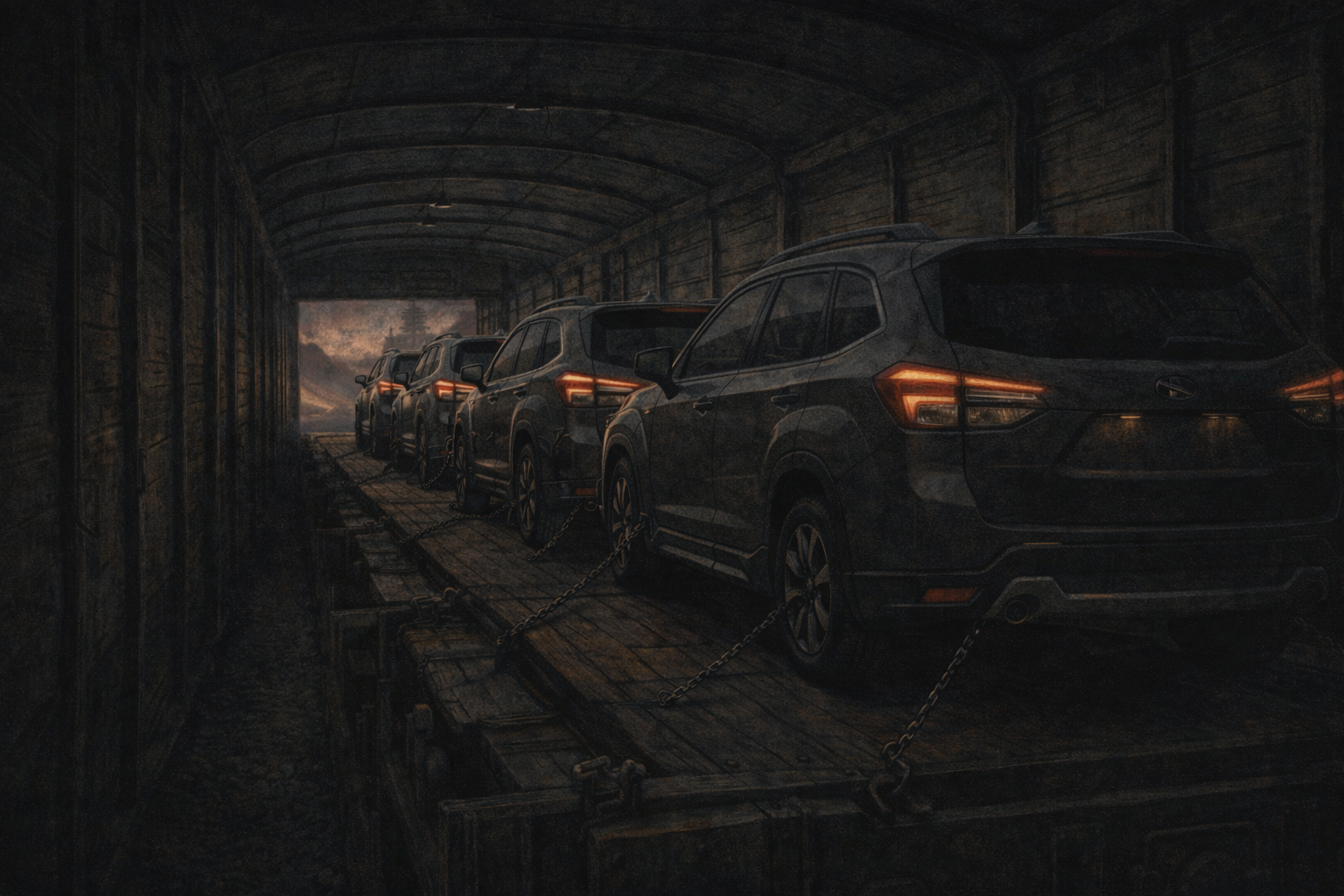
A freight train doesn’t travel like the passenger trains we used to take with Mom to visit aunt in Poznań. It doesn’t glide. It fights the tracks. Every rail joint was a violent strike that traveled through the steel floor of the wagon and vibrated deep within my bones. I was huddled in the backseat of a gleaming, electric SUV that probably cost more than our entire tenement building in the Nadodrze district. I felt like an intruder. The leather upholstery smelled of "new car" and high-end luxury—a scent so clean it felt like an insult compared to my soaked jeans and grime-streaked hands.
But the worst part wasn't the smell; it was the weight. Not just my own, though I felt like I weighed a ton, but the weight of the air... and the sheer gravity of the situation we had fallen into.
“Gogo, calm down, or you’re going to rip those doors right off the hinges,” Marmar muttered, his eyes never leaving the black cube.
I didn't understand what he meant until I shifted my weight away from the door. My eyes widened. The heavy reinforced steel of the SUV's door was buckled outward, warped by the simple pressure of my shoulder as if I were made of solid lead.
Marcel was sitting in the front seat, his back to me. The car’s dashboard was dark and dead, but to him, it clearly wasn't. In the rearview mirror, I could see his pupils darting back and forth, his fingers ghosting over the black plastic trim. He was squinting, his brow furrowed as if he were reading invisible lines of code scrolling across the air.
“I’m trying,” I growled, though my voice came out more like a whimper. “It’s just... it feels like someone switched the gravity settings on me. Everything is too light. This car, this wagon, even you guys. I feel like if I stomp my foot too hard, I’ll punch a hole through the floor of this train and end up on the gravel.”
Julix was asleep in the passenger seat next to Marmar. Her head hung limply, and her face, usually so vibrant and full of fire, was pale and haunted by deep shadows. The escape from the station and that "humming" of hers had drained every ounce of her strength. She looked so fragile that, for a moment, I forgot my own terror. She was the one who got us out of there. My big sister, who only this morning was screaming at me for drinking the last of the milk, was now the only reason we were still breathing.
I closed my eyes, trying to drown out the rhythmic thrum-clack of the wheels. I wanted to go home. Not to the home that was currently burning and crawling with armored agents, but to the home of last year.
The memory hit me suddenly, like a wave of warm wind blowing off the Odra River. Marina Kleczków. It felt like it happened only seconds ago, though it had been May of last year. Back then, Wrocław smelled of blooming chestnut trees and sun-baked concrete that exhaled heat long into the evening. Dad had taken us for a walk down by the river. I remember how the sun hung low over the water, staining the Odra a deep, bruised orange. We sat on the wooden piers of the Marina, eating ice cream that melted and dripped onto our shirts.
The "Jazz on the Odra" festival was in full swing. From a nearby stage, the frantic, soulful sounds of a trumpet and a double bass drifted over the water—the kind of music we didn't usually listen to, but there, by the river, it was perfect. It was chaotic, unpredictable, and utterly free. Exactly how we felt back then.
“Come on, Elena!” Dad had shouted, grabbing Mom’s hand.
He started dancing on the grass, completely unbothered by the people watching. Mom laughed with that crystal-clear voice of hers, throwing her head back while her dress swirled in time with the rhythmic melody. Julix joined them a moment later, spinning in pirouettes with such grace it looked like gravity simply didn't apply to her. Marmar sat next to me, trying to explain the mathematical structure of jazz—polyrhythms and syncopation—but even he eventually gave in and started tapping his foot to the beat.
I remember Dad walking over to me. He picked me up and swung me high—I was lighter then, or maybe he was just stronger. He looked me in the eye and said:
“Ignacy, remember this rhythm. Life isn’t always a simple song with a predictable chorus. Sometimes, it’s jazz. You have to learn to improvise when the notes stop fitting together.”
At the time, I thought it was just "Dad-talk"—one of those poetic things parents say that don't really mean anything. But now, in the shivering darkness of a freight wagon, his words hit me with the force of a sledgehammer. The notes had stopped fitting together a long time ago. We were stuck in the middle of the most terrifying composition imaginable.
“Gogo? Are you crying?” Marmar’s voice pulled me out of Marina Kleczków and back into our metal tin can.
“No. It’s just... dust in this fancy car,” I lied, wiping my eyes with the back of my hand. My skin felt strange again—rough, almost like stone under my fingertips. “Marmar, what are you actually doing with that cube?”
My brother sighed and turned toward me. In the thin slivers of moonlight filtering through the wagon's high vents, his glasses glinted like two small computer screens.
“I’m trying to understand its geometry. This isn't a normal device, Gogo. Dad gave it to me for a reason. It reacts to... to the way I see things. When I focus on it, I don’t see a solid object. I see layers of data that aren't stored on a hard drive, but in the very structure of the metal itself. It’s like every molecule is a bit of information.”
“And what’s in there?” I asked, leaning closer. The SUV groaned under my shifting weight.
“Coordinates. But more than that. There’s something called an 'Initiation Sequence.' And our names, Gogo. Yours, Julka’s, and mine. We are listed in here as... components.”
A chill washed over me that had nothing to do with the temperature. Components. Like parts of a machine. Or parts of an experiment. The Triad—that’s what Dad had called us.
Suddenly, the train lurched. The brakes began to squeal, a sound so shrill and piercing that Julix bolted upright, gasping for air.
“Where are we?” she asked, her voice still vibrating with that strange, metallic resonance.
“Approaching the border,” Marmar whispered, peering through a crack in the wagon wall. “I see them. Not just border guards. Those same heat signatures from Wrocław. Eterna Corp didn't give up. They’re waiting for this transport.”
“How did they find us?” Julka rubbed her face, trying to wake up. “Marcel, you said you scrubbed us from the cameras!”
“I did!” my brother hissed. “But they aren't looking for images. They’re looking for anomalies. Every time you use your... gifts, you leave a footprint on the environment. Gogo, when you hit that platform, you sent out a seismic wave that probably registered on stations across the whole province. Julka, your bio-acoustics scrambled the local radio bands. They’re like hunters following broken branches in a forest.”
The train came to a complete, shuddering halt. The silence that followed was worse than the loudest jazz. All we could hear was the tink-tink-tink of the cooling engine and the distant, lonely barking of dogs.
“They’re coming here,” Marmar said. His eyes were darting wildly now, analyzing the very atoms of the wagon walls. “Three on the left, four on the right. If we stay in the car, they’ll find us in ten seconds.”
“Then what do we do?” I felt my heart begin to hammer against my ribs. Every beat was like a drum-strike. I felt my skin hardening again, a layer of invisible armor plating forming around my shoulders and chest.
Julix looked at me. The exhaustion was gone, replaced by a cold, sharp determination—the same look she had at the Marina when she was teaching me not to be afraid of deep water.
“Gogo, remember what Dad said? We have to improvise.”
“I don’t know how to improvise!” I whispered harshly. “I only know how to... feel heavy!”
“Then feel as heavy as a mountain,” Julka said, her hand reaching for the car's door handle. “Marcel, find us an exit they can't see. And I... I’m going to make them wish they were anywhere else but here.”
We stepped out of the car. I stood on the cold steel floor of the wagon, and for the first time, I realized that gravity wasn't the problem. I was the force. I focused on my feet, on the way they connected to the metal. I could feel every molecule of steel beneath my boots. The air around me began to thicken, turning viscous and heavy, as if the oxygen itself were becoming transparent resin.
From outside, a heavy thud echoed against the wagon doors. A powerful industrial magnet, used to bypass the external locks, groaned. The massive steel doors began to slide open with a terrifying, rhythmic screech.
“Now,” Marmar whispered. “Jump to the right, their visors can't reach that angle.”
But I didn't jump. I stood tall, watching as the gap in the doors grew wider, revealing the black, insect-like silhouettes of agents against the midnight sky. I knew that if I moved now, it wouldn't be to run.
I was Ignacy. I was Gogo. And I wasn't going to let them ruin this song.
As the first beam of a tactical flashlight cut through the darkness of the wagon, I didn't feel fear. I felt the skin on my knuckles turn matte and grey. I felt ready to bounce back anything they threw at us.
“Freeze!” a voice barked from the darkness.
Instead of an answer, Julka took a deep, sharp breath. I knew what was coming. This wasn't jazz. This was a symphony of destruction.
But the worst part wasn't the smell; it was the weight. Not just my own, though I felt like I weighed a ton, but the weight of the air... and the sheer gravity of the situation we had fallen into.
“Gogo, calm down, or you’re going to rip those doors right off the hinges,” Marmar muttered, his eyes never leaving the black cube.
I didn't understand what he meant until I shifted my weight away from the door. My eyes widened. The heavy reinforced steel of the SUV's door was buckled outward, warped by the simple pressure of my shoulder as if I were made of solid lead.
Marcel was sitting in the front seat, his back to me. The car’s dashboard was dark and dead, but to him, it clearly wasn't. In the rearview mirror, I could see his pupils darting back and forth, his fingers ghosting over the black plastic trim. He was squinting, his brow furrowed as if he were reading invisible lines of code scrolling across the air.
“I’m trying,” I growled, though my voice came out more like a whimper. “It’s just... it feels like someone switched the gravity settings on me. Everything is too light. This car, this wagon, even you guys. I feel like if I stomp my foot too hard, I’ll punch a hole through the floor of this train and end up on the gravel.”
Julix was asleep in the passenger seat next to Marmar. Her head hung limply, and her face, usually so vibrant and full of fire, was pale and haunted by deep shadows. The escape from the station and that "humming" of hers had drained every ounce of her strength. She looked so fragile that, for a moment, I forgot my own terror. She was the one who got us out of there. My big sister, who only this morning was screaming at me for drinking the last of the milk, was now the only reason we were still breathing.
I closed my eyes, trying to drown out the rhythmic thrum-clack of the wheels. I wanted to go home. Not to the home that was currently burning and crawling with armored agents, but to the home of last year.
The memory hit me suddenly, like a wave of warm wind blowing off the Odra River. Marina Kleczków. It felt like it happened only seconds ago, though it had been May of last year. Back then, Wrocław smelled of blooming chestnut trees and sun-baked concrete that exhaled heat long into the evening. Dad had taken us for a walk down by the river. I remember how the sun hung low over the water, staining the Odra a deep, bruised orange. We sat on the wooden piers of the Marina, eating ice cream that melted and dripped onto our shirts.
The "Jazz on the Odra" festival was in full swing. From a nearby stage, the frantic, soulful sounds of a trumpet and a double bass drifted over the water—the kind of music we didn't usually listen to, but there, by the river, it was perfect. It was chaotic, unpredictable, and utterly free. Exactly how we felt back then.
“Come on, Elena!” Dad had shouted, grabbing Mom’s hand.
He started dancing on the grass, completely unbothered by the people watching. Mom laughed with that crystal-clear voice of hers, throwing her head back while her dress swirled in time with the rhythmic melody. Julix joined them a moment later, spinning in pirouettes with such grace it looked like gravity simply didn't apply to her. Marmar sat next to me, trying to explain the mathematical structure of jazz—polyrhythms and syncopation—but even he eventually gave in and started tapping his foot to the beat.
I remember Dad walking over to me. He picked me up and swung me high—I was lighter then, or maybe he was just stronger. He looked me in the eye and said:
“Ignacy, remember this rhythm. Life isn’t always a simple song with a predictable chorus. Sometimes, it’s jazz. You have to learn to improvise when the notes stop fitting together.”
At the time, I thought it was just "Dad-talk"—one of those poetic things parents say that don't really mean anything. But now, in the shivering darkness of a freight wagon, his words hit me with the force of a sledgehammer. The notes had stopped fitting together a long time ago. We were stuck in the middle of the most terrifying composition imaginable.
“Gogo? Are you crying?” Marmar’s voice pulled me out of Marina Kleczków and back into our metal tin can.
“No. It’s just... dust in this fancy car,” I lied, wiping my eyes with the back of my hand. My skin felt strange again—rough, almost like stone under my fingertips. “Marmar, what are you actually doing with that cube?”
My brother sighed and turned toward me. In the thin slivers of moonlight filtering through the wagon's high vents, his glasses glinted like two small computer screens.
“I’m trying to understand its geometry. This isn't a normal device, Gogo. Dad gave it to me for a reason. It reacts to... to the way I see things. When I focus on it, I don’t see a solid object. I see layers of data that aren't stored on a hard drive, but in the very structure of the metal itself. It’s like every molecule is a bit of information.”
“And what’s in there?” I asked, leaning closer. The SUV groaned under my shifting weight.
“Coordinates. But more than that. There’s something called an 'Initiation Sequence.' And our names, Gogo. Yours, Julka’s, and mine. We are listed in here as... components.”
A chill washed over me that had nothing to do with the temperature. Components. Like parts of a machine. Or parts of an experiment. The Triad—that’s what Dad had called us.
Suddenly, the train lurched. The brakes began to squeal, a sound so shrill and piercing that Julix bolted upright, gasping for air.
“Where are we?” she asked, her voice still vibrating with that strange, metallic resonance.
“Approaching the border,” Marmar whispered, peering through a crack in the wagon wall. “I see them. Not just border guards. Those same heat signatures from Wrocław. Eterna Corp didn't give up. They’re waiting for this transport.”
“How did they find us?” Julka rubbed her face, trying to wake up. “Marcel, you said you scrubbed us from the cameras!”
“I did!” my brother hissed. “But they aren't looking for images. They’re looking for anomalies. Every time you use your... gifts, you leave a footprint on the environment. Gogo, when you hit that platform, you sent out a seismic wave that probably registered on stations across the whole province. Julka, your bio-acoustics scrambled the local radio bands. They’re like hunters following broken branches in a forest.”
The train came to a complete, shuddering halt. The silence that followed was worse than the loudest jazz. All we could hear was the tink-tink-tink of the cooling engine and the distant, lonely barking of dogs.
“They’re coming here,” Marmar said. His eyes were darting wildly now, analyzing the very atoms of the wagon walls. “Three on the left, four on the right. If we stay in the car, they’ll find us in ten seconds.”
“Then what do we do?” I felt my heart begin to hammer against my ribs. Every beat was like a drum-strike. I felt my skin hardening again, a layer of invisible armor plating forming around my shoulders and chest.
Julix looked at me. The exhaustion was gone, replaced by a cold, sharp determination—the same look she had at the Marina when she was teaching me not to be afraid of deep water.
“Gogo, remember what Dad said? We have to improvise.”
“I don’t know how to improvise!” I whispered harshly. “I only know how to... feel heavy!”
“Then feel as heavy as a mountain,” Julka said, her hand reaching for the car's door handle. “Marcel, find us an exit they can't see. And I... I’m going to make them wish they were anywhere else but here.”
We stepped out of the car. I stood on the cold steel floor of the wagon, and for the first time, I realized that gravity wasn't the problem. I was the force. I focused on my feet, on the way they connected to the metal. I could feel every molecule of steel beneath my boots. The air around me began to thicken, turning viscous and heavy, as if the oxygen itself were becoming transparent resin.
From outside, a heavy thud echoed against the wagon doors. A powerful industrial magnet, used to bypass the external locks, groaned. The massive steel doors began to slide open with a terrifying, rhythmic screech.
“Now,” Marmar whispered. “Jump to the right, their visors can't reach that angle.”
But I didn't jump. I stood tall, watching as the gap in the doors grew wider, revealing the black, insect-like silhouettes of agents against the midnight sky. I knew that if I moved now, it wouldn't be to run.
I was Ignacy. I was Gogo. And I wasn't going to let them ruin this song.
As the first beam of a tactical flashlight cut through the darkness of the wagon, I didn't feel fear. I felt the skin on my knuckles turn matte and grey. I felt ready to bounce back anything they threw at us.
“Freeze!” a voice barked from the darkness.
Instead of an answer, Julka took a deep, sharp breath. I knew what was coming. This wasn't jazz. This was a symphony of destruction.


Comments(0) — Be the first
No comments yet. Be the first to share your thoughts!